Mars
A Princess of MarsMars, known to its inhabitants as Barsoom, is the novel’s setting and the world to which John Carter is mysteriously transported. It first appears as a distant red presence that exerts an almost irresistible pull on him; once he arrives, its strange physical conditions, hostile customs, and fragile systems of life make it far more than an exotic backdrop. The planet’s central contradiction is that its people must cooperate to preserve life, yet their divisions repeatedly turn that need into conflict.
Identity and Physical Setting
From an Arizona mountain, John Carter sees Mars low on the horizon and experiences its appearance as a call across space. He closes his eyes and reaches toward it; after a moment of cold and darkness, he opens them on the planet itself, certain that he is awake and that he has arrived on Mars.
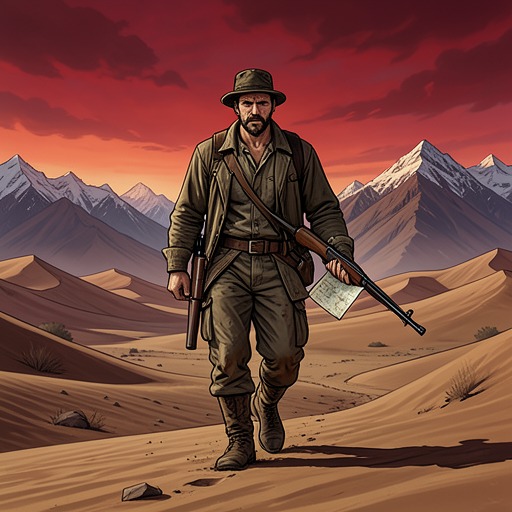
His first view is a vast basin carpeted with yellowish, mosslike vegetation, bounded at its outer edge by low, irregular hills. Under a midday sun, the heat on his naked body seems comparable to that of an Arizona desert. Quartz-bearing rocks catch the light, and a low enclosure stands about a hundred yards away. The scene is not an Earthlike abundance: Carter finds no water and no other vegetation, and thirst immediately turns the unfamiliar landscape into a practical problem to investigate.
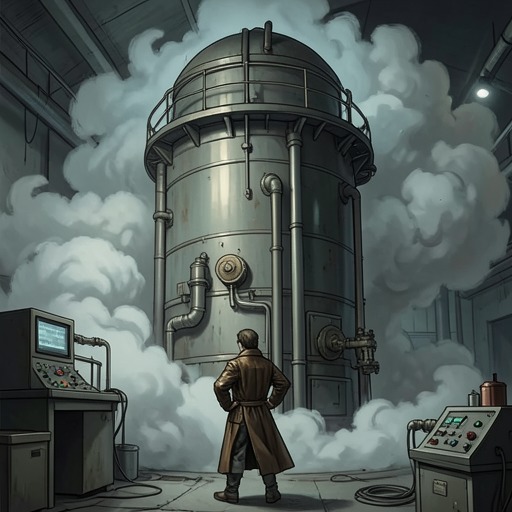
The novel also frames Mars through the human and environmental systems that make life there possible. Dejah Thoris explains that her scientific expedition was measuring air currents and atmospheric density, work she describes as necessary to maintain the planet’s air and water supply. Mars’s survival, in this account, is not simply a feature of its landscape but the ongoing result of labor and knowledge vulnerable to interference.
Inhabitants and Social Customs
Carter’s arrival brings him into contact with green Martian warriors whose physical abilities reflect the planet’s weaker gravity. His unusual agility astonishes them: instead of destroying him, they decide he is a discovery to capture and display. Their weapons give that encounter a further dimension of danger. The rifles Carter observes use radium projectiles and are described as deadly at extraordinary range, making the planet’s technological capacity as consequential as its bodily differences.
The green Martians’ social order is presented through customs that sharply oppose Carter’s assumptions. Their idea of humor, he learns, can take pleasure in the death agonies of others, and prisoners may be killed through ingenious forms of public amusement. Dejah Thoris later condemns a communal system in which property, women, and children are held in common, arguing that the arrangement has left its people hating one another and possessing nothing in common in any meaningful sense. Her speech imagines another possibility: the green and red peoples might join their efforts to help regenerate their declining world.
Mars is not, however, represented only through the green Martians’ practices. After difficult travels, Carter is received hospitably by red Martians, who advise him to establish trust and friends among the nobles of Zodanga through military service. Their practical counsel reflects a society in which martial ability is a route to favor, but also gives Carter a way to pass among the red people after he alters his appearance and adopts their dress.
Conflict and Political Alliances
The planet’s social divisions repeatedly become military conflict. When the red Martian expedition led by Dejah Thoris is attacked, she stresses that it was a peaceful scientific mission and that its work served the interests of the green Martians as well as her own people. Her argument makes the violence more than a clash between armed groups: it interrupts cooperation around the shared requirements of air and water.
The possibility of reconciliation briefly enters the green Martians’ council. Dejah Thoris appeals to them to abandon hostility, join the red people, and take part in the regeneration of Mars. Lorquas Ptomel and the assembled warriors listen in silence; Carter believes they are moved, and Tars Tarkas rises with an expression that suggests a struggle against heredity and custom. The moment suggests that the planet’s divisions are not inevitable, though the appeal alone cannot undo them.
Later, Tars Tarkas assembles a vast force for the march on Zodanga. The column begins three days after preparations, numbering one hundred thousand with the addition of three smaller hordes; on the journey, Tars Tarkas recruits another fifty thousand. They travel at night and shelter by day in deserted cities, reaching the walled city ten days after setting out. Their collective strength is immense, but keeping the warriors in even partial harmony is itself a challenge. As they approach Zodanga, their internal quarrels recede before their shared hatred of the red people and the Zodangans, whose campaigns have targeted green Martian incubators.
Planetary Significance
Mars’s environment and its political conflicts are joined by the question of whether its inhabitants can sustain life on a declining world. Dejah Thoris presents scientific observation and maintenance of air and water as a common necessity, while warfare and destructive interference undermine the cooperation that such work requires. The planet’s fate is therefore tied not only to its technical systems but also to the social choices of the peoples who depend on them.
The narrative’s view of Mars remains shaped by Carter’s perspective: wonder at a distant world gives way to physical exposure, capture, and entanglement in its societies. Yet the planet’s importance exceeds the sequence of his adventures. Its life-supporting work, violent customs, and tentative openings toward alliance repeatedly test whether common survival can overcome inherited hostility.